Asthma and Allergy Awareness Month is a reminder that indoor air quality matters wherever we learn and work.
This Asthma and Allergy Awareness Month, we look at the two indoor environments where Americans spend most of their time, schools and workplaces, and how Certified products can support healthier air for all
When we think about staying healthy, we often focus on diet, ergonomics, or regular breaks. But there is another factor that quietly shapes our well-being every day: the quality of the air we breathe indoors. With Americans spending up to 90% of their time indoors, much of it at school or at work, indoor air quality (IAQ) plays a central role in both physical health and cognitive performance.
Asthma and Allergy Awareness Month is a timely reminder that IAQ matters for everyone, and especially for the 106 million people in the U.S. living with asthma and allergies. In this article, we look at how IAQ shapes life in classrooms and workplaces, the factors that affect it, and how products that are Asthma & Allergy Friendly® Certified can help.
Why Indoor Air Quality Matters
Indoor Air Quality refers to the quality of air within and around buildings, especially in relation to occupant health and comfort. While outdoor pollution often gets more attention, indoor air can be two to five times more polluted than outdoor air.
Poor IAQ has been linked to a range of health concerns, from mild symptoms like fatigue and headaches to more serious outcomes such as respiratory infections, allergy flare-ups, and asthma episodes. With 106 million Americans affected by asthma and allergies, and many spending their days in shared indoor environments, the stakes are significant.
The Air in Our Schools
Children spend up to 1,000 hours in school each year. During that time, the air they breathe can have a profound impact on their health, cognitive performance, and academic outcomes. Research shows that:
- Children breathe 50% more air per pound of body weight than adults, making them more vulnerable to indoor pollutants.
- Children exposed to poor indoor air quality have a higher risk of respiratory issues.
- Improved IAQ can increase cognitive performance by up to 61% (Harvard study, Allen et al.).
These are not just health statistics, they are educational performance metrics, too.
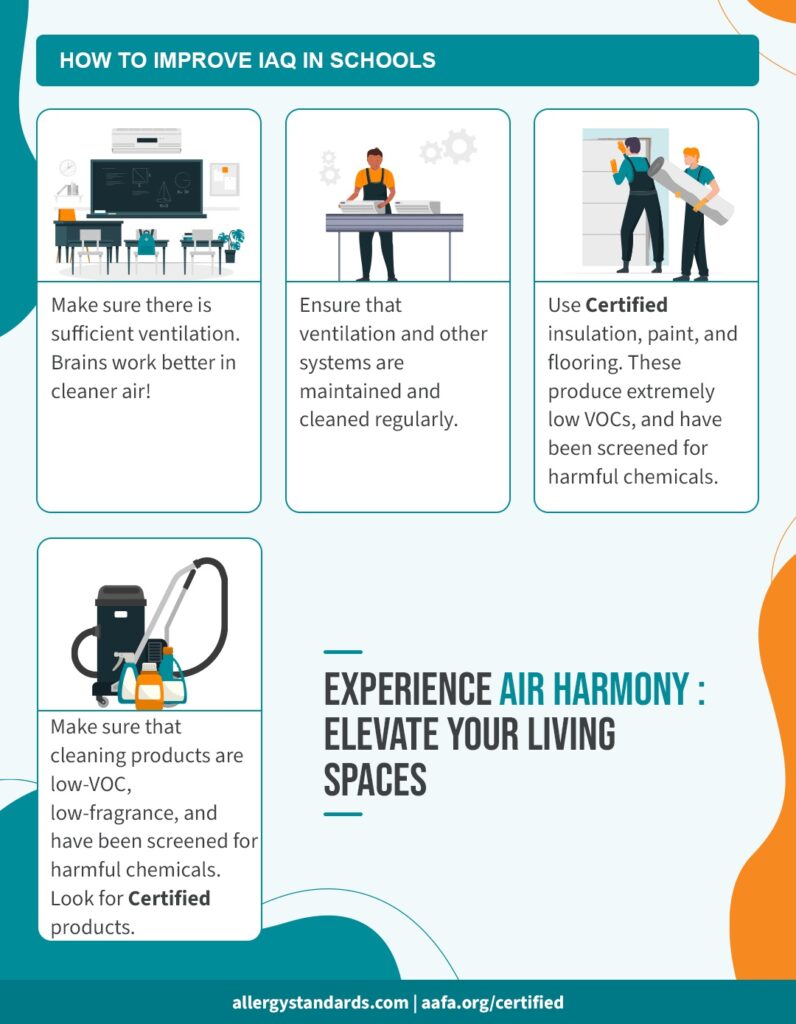
What’s in classroom air?
When indoor air quality is compromised, students may be exposed to a variety of pollutants:
- Dust and mold: Dust harbors allergens like dust mite debris. Mold, common in older or poorly maintained buildings, can trigger or worsen respiratory symptoms.
- Volatile Organic Compounds (VOCs): Emitted by paints, adhesives, flooring, cleaning products, and furnishings, VOCs can contribute to poor IAQ and long-term health concerns.
- Bacteria and viruses: Crowded classrooms with poor ventilation can allow pathogens to spread quickly, increasing absenteeism.
- Excess CO₂: Elevated carbon dioxide levels due to poor ventilation can lead to drowsiness, headaches, and reduced attention spans.
- Outdoor pollution: Traffic-related emissions from idling buses or cars can infiltrate classrooms, especially in urban schools.
Poor IAQ in schools may affect both physical health and academic success. It may aggravate asthma and allergies, cause headaches and fatigue, impair concentration, and increase absenteeism. It also affects teachers and staff, reducing comfort and contributing to turnover. A healthy indoor environment supports the whole school community.
The Air at Our Workplaces
The same principles apply when the school day ends and the workday begins. “Sick Building Syndrome”, a term coined in the 1970s, described the health problems caused by inadequate ventilation and pollutant buildup in tightly sealed office buildings. Though the term is used less often today, the underlying issues remain, manifesting in symptoms such as eye irritation, dizziness, and respiratory distress, which often resolve once a person leaves the affected building.
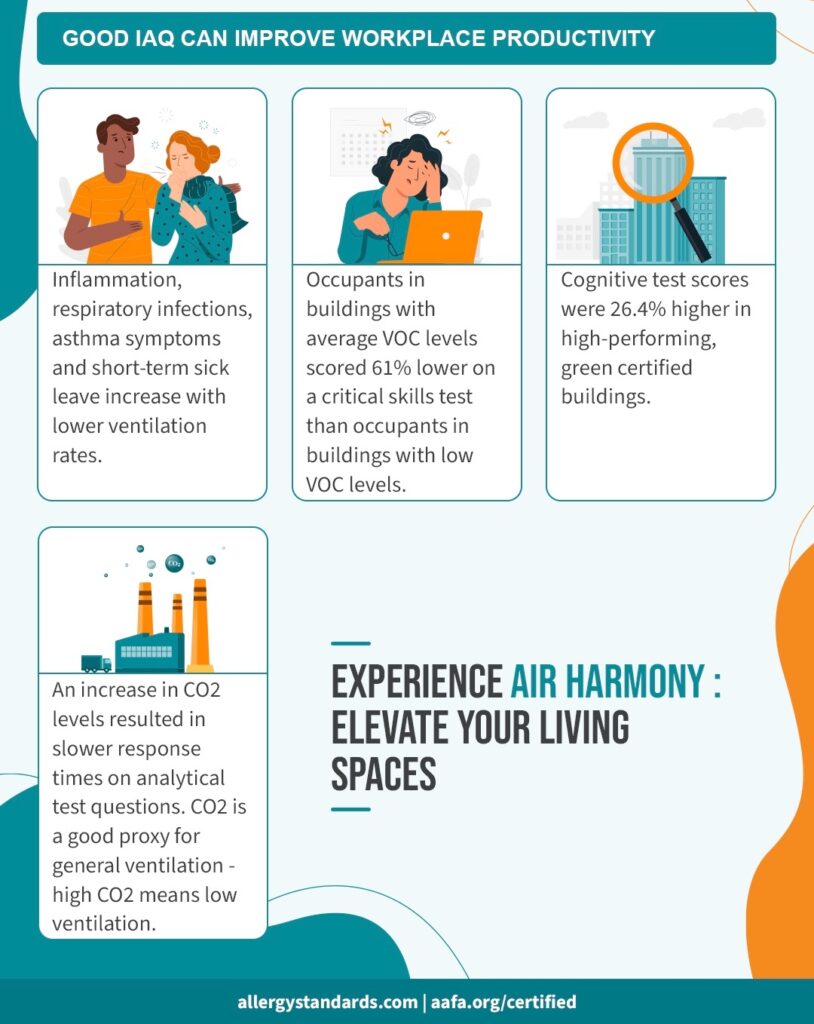
The consequences of poor workplace IAQ go beyond physical health. Buildings with high VOC levels have been associated with significantly lower performance on cognitive tests compared to low-VOC environments. In contrast, workers in green-certified buildings, which typically feature better ventilation and material choices, showed a 26.4% improvement in cognitive test performance.
Key workplace factors that impact IAQ
Several elements can influence indoor air quality in the workplace:
- Poor ventilation: Insufficient ventilation allows pollutants like CO₂, VOCs, and particulate matter to accumulate, degrading air quality and impairing cognitive function.
- HVAC systems and filters: HVAC systems that are poorly maintained or equipped with inadequate filters can recirculate dust, allergens, and mold spores.
- VOCs from materials: Paints, adhesives, flooring, insulation, and cleaning products can emit VOCs over long periods.
- Flooring and insulation: These materials can trap dust, moisture, and allergens, and some may release VOCs over time. Inadequate cleaning or moisture buildup can also lead to mold growth.
- Cleaning products: Conventional cleaners often contain harsh chemicals that can aggravate asthma and allergies.
Evidence-Based Design: A Shared Solution
Evidence-based design, originating in healthcare, is increasingly applied to schools, offices, and other commercial spaces. It emphasizes decision-making based on scientific evidence to create environments that support human health and performance.
In the context of IAQ, evidence-based design supports the use of low-emitting materials, optimized ventilation strategies, and independently certified products to reduce pollutants and enhance occupant well-being. By integrating research-backed solutions, school administrators, employers, and designers can make smarter decisions about the materials and systems that define learning and working environments.
Practical Steps to Improve IAQ at School and Work
Improving IAQ does not require massive overhauls. Small, evidence-based changes can make a meaningful difference in both schools and workplaces:
- Increase ventilation. Open windows when outdoor air quality is good, maintain exhaust systems, and ensure HVAC systems operate efficiently and are fitted with Certified HVAC filters.
- Choose low-VOC materials. Renovations and new furnishings should prioritize low-emitting materials. Asthma & Allergy Friendly® Certified flooring, insulation, and paints are tested to emit fewer harmful chemicals.
- Maintain HVAC systems. Replace filters regularly using trusted solutions such as Filtrete™ Air Filters from 3M and Kleenex® air filtration products, which offer Asthma & Allergy Friendly® Certified filtration.
- Control humidity. Maintain humidity between 40 and 50% to deter mold growth. Promptly repair leaks and any water damage.
- Upgrade flooring. Choose flooring that is easy to clean and low-emitting. Asthma & Allergy Friendly® Certified flooring is tested for easier allergen removal without increasing airborne levels during and after cleaning.
- Use Certified air purifiers. Air purifiers tested to reduce airborne allergens effectively are a strong addition to classrooms and workplaces.
- Choose Certified cleaning products. Daily cleaning should support a healthier indoor environment, not detract from it. Asthma & Allergy Friendly® Certified cleaning products are tested to remove allergens and emit minimal VOCs.
- Ban vehicle idling around schools. Implement no-idling zones to limit pollution from buses and cars.
How the Asthma & Allergy Friendly® Certification Program Helps
The Asthma & Allergy Friendly® Certification Program, a joint partnership between the Asthma and Allergy Foundation of America (AAFA) and Allergy Standards Ltd, identifies products that support healthier indoor air through rigorous scientific testing.
Products that earn certification are tested to:
- Reduce or trap allergens effectively
- Emit low levels of VOCs and other pollutants
- Maintain performance over time and under real-life conditions
This holistic approach evaluates not only emissions but also allergen control, cleanability, and product longevity, all critical factors for maintaining healthier indoor environments.
Terms like “hypoallergenic” are unregulated marketing language. The Asthma & Allergy Friendly® Certification Program offers independent, science-based validation that products meet stringent criteria.
Our Certified Partners: Building Healthier IAQ at School and Work
We work with industry-leading brands across key product categories to help schools and workplaces improve air quality:
- HVAC filters: 3M Filtrete™, Kleenex
- Air purifiers: Blueair, LG Electronics, Rabbit Air, Alen, CleanForce
- Cleaning products: Renegade Brands, Granite Gold
- Insulation: Knauf Insulation, Manson Insulation
- Flooring: Tarkett, Mohawk Industries
- Paint: Benjamin Moore, True Value, Master Paints
Each of these partners has earned certification by demonstrating that their tested products meet the high standards set by the Asthma & Allergy Friendly® Certification Program. By choosing these products, school administrators, facility managers, designers, and business leaders can make measurable investments in occupant wellness and environmental responsibility.
Why Certified Products Make a Difference
Certified Asthma & Allergy Friendly® flooring, insulation and paint meet LEED criteria for low-emitting materials and comply with WELL Feature X06 Part 1b4.
Healthier environments. Certified products help reduce exposure to allergens and irritants, making schools and workplaces more inclusive for students, teachers, and employees with asthma, allergies, or chemical sensitivities.
Better performance. Research shows cleaner air is associated with improved decision-making, reduced absenteeism, and higher cognitive function, benefits that translate to real-world performance in both classrooms and offices.
ESG and sustainability alignment. Certified products can contribute to LEED credits and WELL Building Standard compliance, helping schools and businesses demonstrate commitment to health, sustainability, and measurable outcomes.
Conclusion: Healthier Air for Every Indoor Space
According to the EPA, half of U.S. schools have issues with indoor air quality. The story is similar across many workplaces. With so much at stake, including health, attendance, productivity, and academic success, improving indoor air is not optional, it is essential.
As Asthma and Allergy Awareness Month draws to a close, whether you are a school administrator, teacher, employer, facility manager, or policymaker, consider how Asthma & Allergy Friendly® Certified products and evidence-based building practices can help create healthier environments for everyone who learns, works, and grows inside them.