How Choosing Independently Certified Insulation Can Reduce Allergens, Limit Harmful Chemicals, and Support Healthier Indoor Environments
May is Asthma and Allergy Awareness Month, designated by the Asthma and Allergy Foundation of America (AAFA) since 1984 to raise awareness about the wide impact of asthma and allergies and to highlight the importance of diagnosis, treatment, and ongoing management of these conditions. With more than 106 million Americans affected by asthma and allergies, May is a meaningful moment to consider how the buildings we live and work in shape the air we breathe.
May is also National Building Safety Month, with a 2026 theme of “Built to Last,” highlighting how thoughtful planning, informed product choices, and resilient building practices help create safer, stronger, and healthier communities. The two observances overlap naturally, because the materials we build with shape the indoor environment long after construction is finished. Insulation is one such material. Hidden behind walls and tucked into attics and floor cavities, it is easy to overlook, but it plays a meaningful role in supporting healthier indoor air quality (IAQ).
In this article, we explore how insulation affects IAQ, why third-party certification matters, and introduce our Certified insulation partner Knauf North America.
Why Indoor Air Quality Matters
IAQ affects everyone, but it is especially important for individuals with respiratory conditions, those with asthma or allergies, the very young, and the very old. Every day, we breathe in over 2,000 gallons of air, enough to fill a standard swimming pool. That air can carry dust, pollen, pet dander, and other airborne allergens, all of which may trigger asthma attacks and allergic reactions.
Indoor dust can also carry consumer-product chemicals such as certain phthalates and flame retardants. Research has consistently identified these chemicals in the majority of household dust samples tested across U.S. homes, with several studies reporting detection in over 90% of samples. Some of these chemicals are associated with potential health concerns, so reducing dust and limiting chemical sources in the first place can help limit exposure.
Choosing the right insulation can help reduce allergens, limit exposure to harmful chemicals, and prevent the conditions that allow mold to grow. Understanding how insulation contributes to IAQ helps homeowners, builders, and specifiers make more informed decisions about the materials that go into healthier living environments.
How Insulation Affects Indoor Air Quality
Insulation plays a significant role in maintaining a comfortable, energy-efficient home by regulating temperature and reducing energy costs. However, not all insulation materials are equal when it comes to IAQ. Some materials can off-gas volatile organic compounds (VOCs) into the air, while others may encourage mold growth if they retain moisture. When improperly installed or when disturbed during renovation, insulation materials can release airborne dust, fibers, and other particles that contribute to poor IAQ.
These concerns affect not only residents but also the installers and tradespeople who work directly with the material. Choosing insulation that has been independently tested for low emissions, mold resistance, and minimal dust release supports better outcomes for everyone involved, from initial installation through years of occupancy.
The Importance of Third-Party Certification
To ensure that insulation meets meaningful standards for supporting better IAQ, it is essential to choose products that have undergone independent testing. The Asthma & Allergy Friendly® Certification Program helps consumers, specifiers, and builders identify insulation products that have been scientifically proven to meet strict criteria for IAQ performance.
In a market where terms like “low-VOC,” “eco-friendly,” and “non-toxic” can be used without standardized testing behind them, independent certification provides a credible, science-based alternative. The Asthma & Allergy Friendly® Certification is based on comprehensive, accredited laboratory testing against published, peer-reviewed standards.
How the Asthma & Allergy Friendly® Certification Program Certifies Insulation
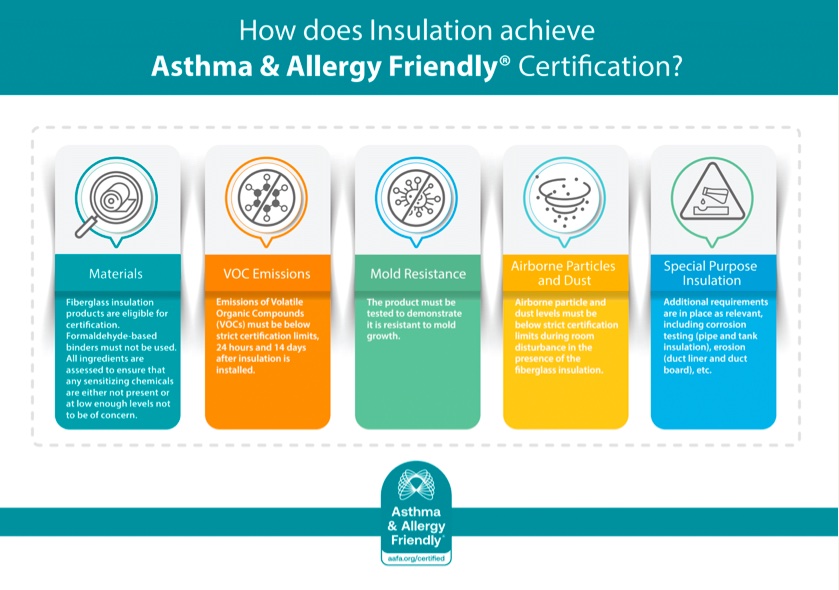
The five key certification criteria for fiberglass insulation to earn the Asthma & Allergy Friendly® mark: Materials, VOC Emissions, Mold Resistance, Airborne Particles and Dust, and Special Purpose Insulation.
Certified insulation products undergo rigorous testing to ensure they meet specific performance standards. These tests include:
Materials: Fiberglass insulation products are eligible for certification. All ingredients are assessed to ensure that any sensitizing chemicals are either absent or present at levels not of concern. Formaldehyde-based binders must not be used.
VOC Emissions: Insulation must meet strict certification limits for VOCs, with emissions tested at 24 hours and 14 days after installation to ensure they remain at safe levels both shortly after installation and over time.
Mold Resistance: The insulation product must undergo testing to demonstrate its resistance to mold growth, helping to prevent one of the most common IAQ concerns.
Airborne Particles and Dust: Insulation must meet certification limits for airborne particle and dust levels during room disturbance when fiberglass insulation is present, ensuring minimal impact on IAQ during installation, renovation, or maintenance.
Special Purpose Insulation: Additional requirements apply to specific insulation types, such as corrosion testing for pipe and tank insulation, and erosion testing for duct liner and duct board.
These tests are carried out in independent, third-party laboratories, ensuring that consumers, specifiers, and builders can trust the certification mark on the product.
Our Certified Insulation Partner: Knauf North America
We are proud to partner with Knauf North America, a Certified partner of the Asthma & Allergy Friendly® Certification Program since 2021. As a leading, family-owned global manufacturer of fiberglass insulation, Knauf’s focus on supporting healthier indoor air quality is evident in their growing range of Certified products. Knauf has expanded its product line to include commercial, residential, and pipe and tank insulation, offering a wide array of solutions for both homes and workplaces.
Linda McGovern, Vice President of Marketing and Customer Experience at Knauf North America, said:
“Our commitment to indoor air quality and sustainability continues to drive innovation at Knauf. With Performance+®, we are raising the bar for insulation and setting a new industry standard that contributes to healthier, safer building environments. From using sustainable materials to pursuing third-party validations like Asthma & Allergy Friendly® Certification, Knauf prioritizes occupant health as a core outcome of its innovation strategy.”
Knauf’s ongoing commitment to certification reflects how thoughtful insulation choices can support both the energy performance and the indoor air quality of the buildings where we live, work, and learn.
Conclusion
As we observe Asthma and Allergy Awareness Month alongside Building Safety Month and its 2026 “Built to Last” theme, insulation is a reminder that the products we cannot see often have the most lasting influence on the air we breathe. From the walls of family homes to the corridors of schools and healthcare facilities, insulation is part of the building fabric for decades.
By choosing Certified Asthma & Allergy Friendly® insulation from trusted manufacturers like Knauf North America, builders, specifiers, and homeowners can be confident that the materials behind their walls support healthier indoor environments, not just at handover, but throughout the lifetime of the building. Through thoughtful product choices and trusted certifications, we can all play a part in shaping spaces that are healthier for the millions of people affected by asthma and allergies, and for everyone who shares those spaces with them.