
Earth Day 2026 | Wednesday, April 22, 2026 Theme: Our Power, Our Planet™
On Wednesday, April 22, communities in more than 190 countries will mark Earth Day under the 2026 theme, Our Power, Our Planet™. This year’s message lands with particular resonance. EARTHDAY.ORG frames it clearly: environmental progress is real, resilient, and ongoing, even when policy winds shift. Cities, schools, Tribal nations, and neighbourhoods continue to build the solutions that strengthen energy reliability, conserve resources, and protect public health, because those solutions make practical sense for the people who live there.
For the Asthma & Allergy Friendly® Certification Program, this year’s theme is a welcome reminder of where our own power lies: in the everyday choices that shape the air people breathe indoors.
A Public Health Emergency, Fuelled by a Changing Climate
Climate change is no longer just an environmental story. It is a respiratory health story. Warmer winters, wetter springs, and rising atmospheric carbon dioxide are driving longer, more intense pollen seasons and worsening air quality. For the estimated 106 million people in the United States living with allergies or asthma, that translates to more symptom days, more missed school and work, and higher healthcare costs.
In March 2026, the Asthma and Allergy Foundation of America (AAFA) released its latest Allergy Capitals® report, and the findings were striking. AAFA President and CEO Kenneth Mendez put it plainly:
“Allergies disrupt sleep, undermine concentration, keep children home from school, and keep adults from work. We are experiencing a widening health threat fueled by climate change. Millions of people in the U.S. live with seasonal pollen allergies, and extreme weather events driven by climate change contribute to the conditions that lead to higher pollen levels and longer allergy seasons.”
AAFA’s 2026 Allergy Capitals: A Map Redrawn by the Weather
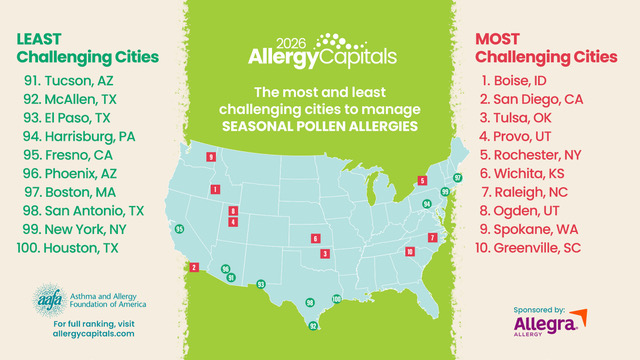
AAFA’s 2026 Allergy Capitals® Report
For years, the top Allergy Capitals clustered across the American Southeast. This year, the list looks very different.
Boise, Idaho took the number one spot for 2026, followed by San Diego, California and Tulsa, Oklahoma. Provo and Ogden in Utah, Rochester in New York, and Spokane in Washington all appear in the top ten, alongside Wichita (Kansas), Raleigh (North Carolina), and Greenville (South Carolina).
Why the shift westward? According to AAFA, late 2024 and early 2025 brought bomb cyclones, atmospheric rivers, and unusually wet winters across the western United States, followed by warm, early springs and, in states like Utah, lingering drought. Those conditions supercharged tree and grass pollen production, pushed weed pollen further into the autumn, and exposed millions more people to longer, more intense allergy seasons. The Allergy Capitals map is, in a very real sense, being redrawn by the weather itself.
Where Our Power Really Lies: Indoor Air
Here is the encouraging part. While we cannot individually control outdoor pollen counts or the behaviour of the jet stream, we spend roughly 90% of our time indoors, and indoor air is an environment we can genuinely shape.
That is precisely why the Asthma & Allergy Friendly® Certification Program exists. Products that carry the CERTIFIED mark (air purifiers, air filters, vacuums, bedding, flooring, paints, cleaning products, washing machines, and more) have been independently and scientifically tested against rigorous standards to confirm they are more suitable for people with asthma and allergies. That means proven allergen reduction, low chemical emissions, and performance claims that stand up in the laboratory, not just on the label.
As outdoor triggers become harder to avoid, a well-managed indoor environment is one of the most powerful levers any household, school, or workplace has.
Five Actions You Can Take This Earth Day
- Track local pollen levels and plan outdoor activity around the forecast, particularly on warm, breezy days.
- Filter and ventilate thoughtfully. Use high-efficiency filters, run a validated air purifier in the bedroom, and keep windows closed on high-pollen days.
- Reduce indoor triggers. Wash bedding weekly in hot water, vacuum with a Certified vacuum cleaner, and choose low-emission cleaning products.
- Choose Certified. When you replace an appliance, bedding, or a cleaning product, look for the Asthma & Allergy Friendly® CERTIFICATION mark.
- Act locally. Join a community clean-up, support your school’s indoor air quality efforts, or attend an Earth Week event near you. Local action is where the theme comes alive.
Earth Day 2026: Our Power, Our Planet, Our Lungs
The 2026 theme speaks to something the Asthma & Allergy Friendly® Certification Program has always believed: meaningful change comes from consistent, community-level choices. Every Certified product placed in a home, school, or workplace is one more step toward indoor environments that support healthier indoor air for the millions of people affected by asthma and allergies, on Earth Day, and on every day that follows.