Certified robot vacuums are independently tested to show they effectively reduce allergens from floors while keeping particle emissions low
Keeping floors clean is an important part of maintaining good indoor air quality. Floors, carpets and rugs collect dust, dirt and common allergens like dust mite allergen, pet dander and pollen. These can easily become airborne again as we move around our homes. If someone in your home is impacted by asthma or allergies, floors can be a significant source of indoor triggers.
Robot vacuums have become a popular way to keep on top of this. They can run daily and on a schedule, so they help keep allergen levels on floors down between deeper cleans. But as with any vacuum, how well a robot vacuum captures and contains what it picks up matters just as much as how much it picks up.
This Indoor Air Quality Awareness Month, we’re looking at why floor cleaning matters for IAQ, and how the Asthma & Allergy Friendly® Certification Program independently tests robot vacuums against strict, science-based standards.
Why Floor Cleaning Matters for IAQ
Americans spend, on average, about 90% of their time indoors, and the U.S. Environmental Protection Agency has ranked indoor air pollution among the top five environmental risks to public health. Regular vacuuming is an important part of maintaining good IAQ, especially for the more than 106 million people in the U.S. who experience asthma and/or allergies each year and the more than 28 million living with asthma.
Floors can harbor large amounts of dust, allergens and irritants, which can easily become airborne. A vacuum cleaner that effectively removes these allergens, and prevents them from re-entering the air and reaching the ‘breathing zone’, is a key part of managing indoor environmental triggers. However, a vacuum that doesn’t capture and contain what it collects can release fine particles back into the air, either through its exhaust or when the dust bin is emptied.
What Makes Robot Vacuums Different?
One of the main advantages of a robot vacuum is frequency. Because it can run every day without any effort on your part, floors are cleaned more often, and allergens have less time to build up.
That frequency is also why performance matters. A robot vacuum works at floor level, may run while people are at home, and many models now empty into a docking station. If a robot vacuum releases particles while cleaning or emptying, that happens every time it runs. A certified robot vacuum must show that it removes allergens effectively and keeps them contained.
There is another key advantage. With a traditional vacuum, whoever is doing the vacuuming is right beside the dust and allergens it can disturb. With a robot vacuum, the person in your household who has asthma or allergies does not need to be in the room while the floors are cleaned, or even in the house. Schedule it to run while they are at work, at school or out for the day. This helps reduce their exposure even further, on top of the low emissions a certified robot vacuum has already been tested to deliver.
How Does a Robot Vacuum Earn Asthma & Allergy Friendly® Certification?
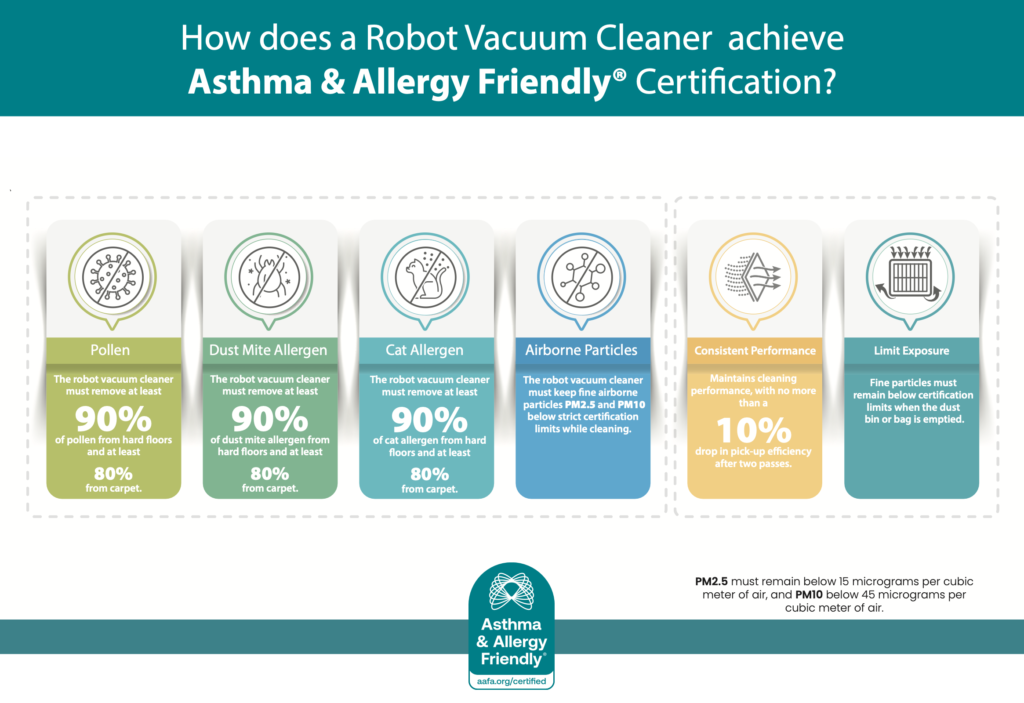
Robot vacuums must meet strict standards for allergen removal, airborne particles, consistent performance and dust bin emptying to earn Asthma & Allergy Friendly® Certification.
The Asthma & Allergy Friendly® Certification Program tests robot vacuums under controlled conditions at independent third-party laboratories. To earn certification, a robot vacuum must meet these requirements:
- Remove allergens from floors: Remove at least 90% of tested allergens from hard floors and at least 80% from carpet. Allergens assessed under the standard include cat, dust mite and pollen allergens.
- Effectively remove household dust: Remove at least 75% of test dust from hard floors and at least 40% from carpet.
- Limit airborne particles and allergens during use: Keep fine airborne particles and cat allergen below strict certification limits while vacuuming.
- Maintain low particle emissions: Keep fine particle emissions low even when operating on a clean floor, demonstrating that the vacuum itself does not release excessive dust into the air.
- Maintain pick-up performance: Demonstrate no more than a 10% loss in pick-up efficiency after two passes.
- Limit exposure when emptying the dust bin: Keep fine particles and cat allergen below certification limits during dust bin emptying.
Together, these requirements mean a certified robot vacuum has been shown to remove allergens from floors, keep what it collects contained and perform consistently.
Why Third-Party Certification Matters
Many robot vacuums are marketed with claims about suction, filtration and allergen control, but these claims are not always independently tested. The Asthma & Allergy Friendly® Certification Program is a collaboration between the Asthma and Allergy Foundation of America (AAFA) and Allergy Standards Limited (ASL). Every certified product is tested to strict standards at independent laboratories, so the certification is based on scientific evidence rather than marketing.
When you see the Asthma & Allergy Friendly® Certification Mark on a robot vacuum, you know that specific product has been tested and has met the Program’s standards for allergen removal, particle emissions and consistent performance.
Practical Tips for Using Your Robot Vacuum
- Schedule regular cleaning: Set your robot vacuum to run daily, focusing on high-traffic areas, entryways and rooms where pets spend time. Where possible, schedule it for times when anyone with asthma or allergies is out of the room or away from home.
- Clear the floor first: Pick up cables, toys and clutter so the vacuum can reach as much of the floor as possible, including under furniture where dust collects.
- Maintain filters and brushes: Follow the manufacturer’s instructions for cleaning or replacing filters, brushes and dust bags. A clogged filter or tangled brush roll will reduce performance.
- Empty carefully: If your robot vacuum doesn’t have a self-emptying dock, empty the dust bin outdoors or in a well-ventilated area. If it does, change the dock’s dust bag carefully, outdoors if you can. Ideally, ask someone without asthma or allergies to take care of this.
- Use it alongside a full vacuum: A robot vacuum works best together with regular cleaning using a certified upright or stick vacuum. This covers stairs, upholstery, mattresses and curtains. Mattresses and upholstered furniture in particular are where dust mites thrive.
Our Certified Robot Vacuum Partner: Anker eufy
We are delighted to welcome Anker eufy as our newest certified partner. The Anker eufy Robot Vacuum Omni E35 has earned the Asthma & Allergy Friendly® Certification, giving households a science-backed option for reducing allergen exposure during everyday cleaning.
Anker eufy describes itself as specializing in AI-driven smart living solutions. Since 2016, eufy has introduced a wide range of products, including home security systems, robot vacuums, robot lawn mowers, baby care and personal health devices. Its parent company, Anker Innovations, is a consumer technology company founded in 2011. It serves more than 200 million customers across more than 180 countries and regions.
Final Thoughts
Good indoor air quality starts with the surfaces we live on every day. A certified robot vacuum has been tested to show it effectively reduces allergens from floors, keeps particle emissions low and performs consistently. And because it can run while the person with asthma or allergies is out of the room, or out of the house, it can help reduce their exposure while floors are cleaned. That makes it a useful part of your overall IAQ routine. This Indoor Air Quality Awareness Month, look for the Asthma & Allergy Friendly® Certification Mark to find a robot vacuum that has been independently tested to strict standards.