Certified HVAC filters are designed to meet rigorous standards for particle removal, helping you make informed, science-backed product choices.
As awareness grows about the air we breathe, and with over 100 million Americans affected by asthma and allergies, the importance of maintaining good indoor air quality (IAQ) has never been clearer. While people with asthma or allergies are particularly sensitive to poor air quality, improving IAQ benefits everyone’s health and well-being.
This is where HVAC (Heating, Ventilation, and Air Conditioning) filters make a difference. These filters play a critical role in supporting a healthier indoor environment by trapping and reducing airborne particles that can affect respiratory health.
On average, we breathe about 2,000 gallons of air each day, and most of it is indoors, where pollutant levels can be two to five times higher than outdoor air. Climate change is compounding these challenges, lengthening allergy seasons, raising pollen counts, and increasing asthma triggers. Together, these factors show the growing need to improve IAQ, particularly for vulnerable populations.
HVAC systems and filters can be useful tools for reducing exposure to airborne allergens like pollen, dust mite particles, and pet dander. In this article, we’ll explore how HVAC filters contribute to cleaner indoor air and why independent certification matters when choosing filters you can trust.
Why Indoor Air Quality Matters and How HVAC Filters Work
IAQ is a fundamental factor in creating a healthy living space, especially for people with asthma or allergies. Pollutants such as pollen, dust mite allergen, pet dander, and mold spores can accumulate indoors and become airborne within the breathing zone, leading to respiratory issues and exacerbating symptoms for those with sensitivities. Poor IAQ has been linked to a range of health problems, including asthma, allergic reactions, and long-term respiratory conditions.
In many homes, HVAC systems are the primary means of circulating air and are designed to trap and remove a variety of airborne contaminants, including allergens like pollen, dust mite allergen, and pet dander. By preventing these particles from recirculating throughout your home, HVAC filters reduce common asthma and allergy triggers.
However, these systems can also distribute allergens and other harmful particles throughout the home if they aren’t equipped with effective filtration systems. This makes the choice of HVAC filters crucial in managing and improving indoor air quality.
Choosing Independently Tested and Validated HVAC Filters
When selecting a filter for your HVAC system, it’s important to choose one that has been independently tested and validated for its effectiveness in improving IAQ. The Asthma & Allergy Friendly® Certification Program provides this assurance. Products that receive this certification have undergone rigorous testing to meet strict criteria for reducing allergens and improving overall air quality in your home.
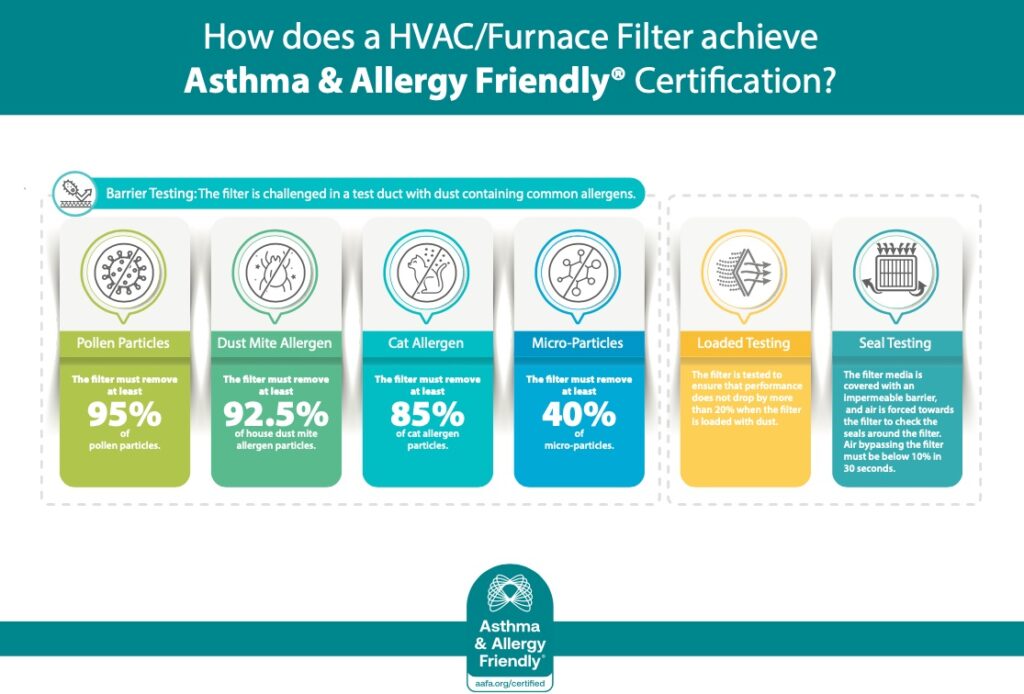
CERTIFIED HVAC/Furnace Filters are tested for the following:
Allergen and Particle Removal:
Filters are challenged in a test duct containing dust with common allergens. To achieve Certification, filters must meet the following minimum performance levels:
-
Remove at least 95% of pollen particles
-
Remove at least 92.5% of house dust mite allergen particles
-
Remove at least 85% of cat allergen particles
-
Remove at least 40% of micro-particles
Loaded Performance Testing:
Filters are tested to ensure consistent performance over time. The filter’s efficiency must not drop by more than 20% when it becomes loaded with dust.
Seal Integrity Testing:
To ensure clean air is passing through the filter rather than around it, the filter media is covered with an impermeable barrier and air is forced toward the filter to check for leaks. Air bypassing the filter must remain below 10% within 30 seconds.
The Importance of Certification
Choosing an independently tested and validated HVAC filter, such as those certified by the Asthma & Allergy Friendly® Certification Program, provides peace of mind that you are making an informed decision for your home’s air quality.
Terms like “hypoallergenic” are often used as marketing tools, but they are largely unregulated and can be misleading. Manufacturers are free to use the term without needing to prove their claims. This is where third-party certification becomes invaluable. Independent certifications, such as the Asthma & Allergy Friendly® Certification Program, go beyond marketing claims by subjecting products to scientifically strict testing to ensure that they meet rigorous standards.
This certification is more than just a label; it indicates that the product has met stringent standards for allergen reduction, performance in real-world conditions, and overall effectiveness in improving indoor air quality.
Our Certified Partners: Kleenex® Air Filters and Filtrete™
We are proud to work with Kleenex® Air Filters from Kimberly-Clark and Filtrete™ Air Filters from 3M as Certified partners in the Asthma & Allergy Friendly® Certification Program.
Kleenex Air Filters: Kleenex Air Filters joined the Certification Program in February 2025, bringing one of America’s most trusted household names into the family of Certified HVAC filters. On achieving the certification, Sharnell Weathersby, Associate Director of New Categories at Kimberly-Clark, said:
“Kleenex is already a household name dedicated to life’s moments, and with the addition of the new Kleenex Air Filters we support a healthier indoor environment for your home and family. We are especially proud of the Asthma & Allergy Friendly® certification that helps demonstrate our commitment to quality and helping improve indoor air quality.”
Since joining the program, Kimberly-Clark has continued to extend the reach of Kleenex Air Filters through initiatives that bring cleaner indoor air to homes and communities across the country, reinforcing the brand’s long-standing commitment to family wellbeing.
Filtrete: A trusted name in air filtration, Filtrete™ has been part of the Asthma & Allergy Friendly® Certification Program for 12 years, making it one of the program’s longest-standing partners. With a strong reputation for quality and innovation, Filtrete™ offers a range of filters that meet the rigorous standards of the program. The 3M brand promise of “Science Applied to Life” is mirrored in our shared commitment to science, innovation, and consumer trust. Over the years, Filtrete™ has expanded its product range to include multiple Certified air filters designed to improve indoor air quality in homes nationwide.
Conclusion
Indoor air quality is a fundamental aspect of maintaining a healthy home environment, especially for those with asthma and allergies. HVAC filters play a significant role in improving IAQ by reducing allergens and micro-particles.
By choosing independently tested and validated products, such as those Certified by the Asthma & Allergy Friendly®Certification Program, you can ensure that your HVAC system is up to the task of providing a healthier environment for you and your family.