How Choosing an Independently Certified Whole Home Air Cleaner Can Reduce Allergens and Support Healthier Indoor Environments
May is Asthma and Allergy Awareness Month, designated by the Asthma and Allergy Foundation of America (AAFA) since 1984 to raise awareness about the wide impact of asthma and allergies and to highlight the importance of diagnosis, treatment, and ongoing management of these conditions. With more than 106 million Americans affected by asthma and allergies, and with symptoms often peaking in spring, May is a meaningful moment to think about how our homes can support better day-to-day wellbeing.
Across this Awareness Month series, we have explored how paint, HVAC filters, portable air cleaners, bedding, cleaning products, and flooring all contribute to indoor air quality (IAQ). Each of these plays an important role in healthier homes, but for households with central forced-air systems, there is another option worth considering: the whole home air cleaner. These systems are designed to address indoor air quality across every room, not just one space at a time.
In this article, we explore how whole home air cleaners work, why third-party certification matters, and how the Asthma & Allergy Friendly® Certification Program tests these systems to give consumers and HVAC professionals confidence in their choice.
Why Indoor Air Quality Matters
We spend up to 90% of our time indoors, and indoor air can be two to five times more polluted than outdoor air. Poor IAQ can be caused by a variety of factors, including dust mite allergen, pet dander, mold, pollen, and volatile organic compounds (VOCs) from household cleaners, paint, flooring, insulation, and furniture. For those with asthma or allergies, these pollutants can trigger symptoms, but poor indoor air can affect everyone’s health, contributing to headaches, fatigue, respiratory irritation, and longer-term health concerns.
Healthier IAQ is especially important for individuals with respiratory conditions such as asthma or allergies, whose airways are more sensitive to airborne pollutants. Reducing the amount of allergens and irritants in the air can meaningfully improve quality of life, minimizing symptoms and helping to reduce asthma exacerbations. But creating a healthier indoor environment benefits everyone in the household, not just those with existing conditions.
What Is a Whole Home Air Cleaner?
Whole home air cleaners, also known as whole-house or in-duct air cleaners, are air purification systems integrated into the ductwork of homes with central forced-air systems. Unlike portable air cleaners that are designed for individual rooms, whole home air cleaners purify the air in every room of the house. They filter out allergens and other particulates as the air circulates through the HVAC system.
The key advantage of a whole home air cleaner is that it can address air quality throughout the entire home, ensuring all spaces benefit from cleaner air. This is particularly important because central forced-air systems circulate air throughout the home, making effective filtration of that circulating air a fundamental part of supporting better IAQ. Whole home air cleaners work alongside HVAC filters to provide an additional layer of allergen and particle capture. With a validated whole home air cleaner in place, the air circulating through the home is being effectively filtered, significantly reducing the presence of airborne allergens and other irritants.
Many whole home air cleaners use electrostatic attraction to remove particles from the air. The collecting plates of electrostatic air cleaners are not disposable and do not require frequent replacement, but regular cleaning is needed because the plates can lose efficiency over time as they load with dust. Following the manufacturer’s recommended cleaning schedule is essential to maintain consistent performance.
How Whole Home Air Cleaners Improve Indoor Air Quality
A whole home air cleaner influences IAQ in several important ways:
Comprehensive Coverage: Because the system is integrated into the HVAC ductwork, it treats the air in every room serviced by that system, not just one space. This is a meaningful difference compared with single-room solutions, particularly for larger homes or households where allergen-sensitive individuals move between rooms throughout the day.
Continuous Filtration: Whenever the HVAC system circulates air, the air cleaner is at work. This delivers a more consistent level of filtration than relying on manual operation alone.
Adding a Layer of Filtration: HVAC filters are the first line of defense for airborne particles, and Certified HVAC filters perform especially well in this role. Whole home air cleaners complement that filtration by capturing additional airborne allergens and particles as air circulates through the system, supporting more consistent IAQ across every room
Working Alongside HVAC Filters: Whole home air cleaners are designed to work alongside, not replace, the HVAC filter. A Certified HVAC filter captures common allergens like pollen, dust mite allergen, and pet dander at the system level. A whole home air cleaner adds another layer of allergen and particle capture, supporting a more comprehensive whole-home approach. Used together, they help reduce what circulates through the home
The Importance of Third-Party Certification
While many whole home air cleaners claim to improve IAQ, it is essential to verify these claims through independent testing. In a marketplace full of broad claims like “purifies the air” or “removes 99% of allergens,” third-party certification provides a structured, scientifically rigorous way to confirm that a product performs as advertised.
When a product undergoes independent certification, it is tested by an external organization against published standards rather than evaluated by the manufacturer alone. For homeowners and HVAC professionals making significant investment decisions about whole home systems, this layer of validation matters.
How the Asthma & Allergy Friendly® Certification Program Certifies Whole Home Air Cleaners
The Asthma & Allergy Friendly® Certification Program tests whole home air cleaners against strict, scientifically rigorous criteria to confirm that they reduce allergens, perform reliably, and operate safely. To earn certification, a whole home air cleaner must meet the following performance requirements:
Allergen Reduction: The air cleaner must demonstrate effective reduction of airborne allergens, tested against at least two of the three following allergens. It must remove at least 70% of pollen particles, at least 70% of dust mite allergen particles, and at least 70% of cat allergen particles.
Airborne Particle Reduction: The air cleaner must remove at least 75% of airborne particles from the home.
No Redistribution: Allergen levels are monitored after use to confirm that the reduction is the result of genuine removal, not simply redistribution onto surfaces around the room. This ensures that allergens are being meaningfully reduced from the environment, not just shifted from one place to another.
Low Ozone Emissions: Some air cleaners can generate ozone as a by-product of their filtration process. Ozone can irritate the lungs and worsen respiratory issues, particularly for people with asthma. Certified whole home air cleaners must keep ozone emissions at or below 50 parts per billion (ppb), meeting strict safety standards that align with the Code of Federal Regulations guidelines.
Lasting Performance: The air cleaner must continue to work effectively even after routine cleaning. The manufacturer’s recommended cleaning procedure must restore the device’s performance efficiency, so that the system delivers consistent results over the long term.
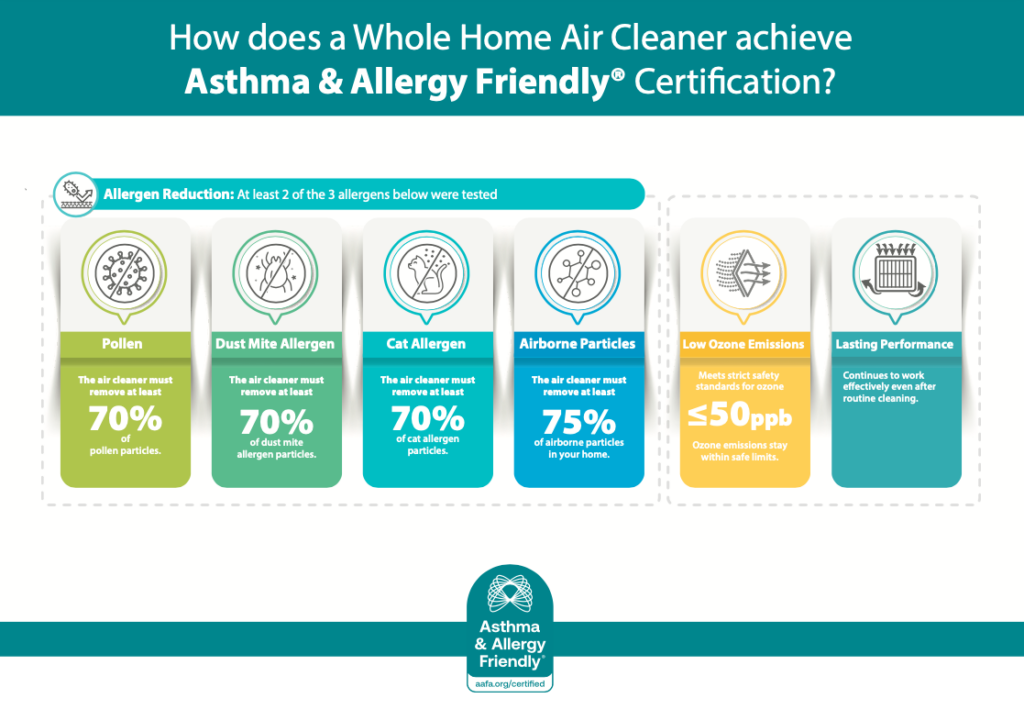
To earn Asthma & Allergy Friendly® Certification, a whole home air cleaner must reduce at least two of three tested allergens (pollen, dust mite, and cat allergen) by at least 70%, reduce airborne particles by at least 75%, keep ozone emissions at or below 50 ppb, and continue to perform effectively after routine cleaning.
Choosing the Right Whole Home Air Cleaner
When selecting a whole home air cleaner, several factors are worth considering to ensure the system genuinely improves IAQ in your home:
Filtration Effectiveness: Look for systems with proven ability to capture common asthma and allergy triggers, including dust mite allergen, pollen, mold spores, and pet dander. Independent certification is the clearest signal that a product performs as claimed.
Ozone Safety: Verify that the system keeps ozone emissions within safe limits, particularly important for households where someone has asthma or another respiratory condition.
Maintenance Requirements: Whole home air cleaners require ongoing maintenance to perform well. Electrostatic systems, for example, may not need frequent filter replacements, but the collecting plates must be cleaned to maintain efficiency. Make sure you understand and can commit to the manufacturer’s maintenance schedule.
Integration with Your HVAC System: Whole home air cleaners are installed within your home’s ductwork, so professional installation and proper sizing for your system are essential.
Our Certified Whole Home Air Cleaner Partners
We are proud to partner with Trane and American Standard, two of the most trusted names in HVAC, both of whom offer Certified whole home air cleaners that meet the Asthma & Allergy Friendly® Certification Program’s rigorous standards.
Trane CleanEffects™: Trane’s CleanEffects™ Whole Home Air Cleaner is Certified by the Asthma & Allergy Friendly® Certification Program for its proven ability to reduce airborne allergens throughout the home. Designed to work with Trane’s central forced-air systems, CleanEffects™ uses advanced filtration technology to capture allergens and irritants as air circulates through the ductwork, helping to deliver consistently cleaner air across every room.
American Standard AccuClean™: The American Standard AccuClean™ Whole Home Air Cleaner is also Certified by the Asthma & Allergy Friendly® Certification Program. AccuClean™ delivers comprehensive filtration through American Standard’s central HVAC systems, providing homeowners with science-backed allergen reduction that has been independently tested and verified.
Both products offer homeowners with central forced-air systems a credible, certified option for taking a whole-home approach to indoor air quality, complementing other Certified solutions across HVAC filters, portable air cleaners, vacuums, and more.
Conclusion
For homes with central forced-air HVAC systems, whole home air cleaners offer a comprehensive way to address indoor air quality across every room, not just one space at a time. By integrating directly into the ductwork, these systems work continuously to reduce airborne allergens and irritants throughout the home.
As we observe Asthma and Allergy Awareness Month, choosing a Certified Asthma & Allergy Friendly® whole home air cleaner gives homeowners the confidence that their system has been independently tested for allergen reduction, ozone safety, and lasting performance. Combined with Certified HVAC filters, cleaning products, bedding, and flooring, a Certified whole home air cleaner forms part of a meaningful whole-home strategy to support healthier indoor environments for everyone in the household.