How Certified Asthma & Allergy Friendly® Treated Carpet Supports Better Management of Indoor Allergen Exposure
Most of us spend around 90% of our time indoors, and according to the U.S. Environmental Protection Agency, the air inside our homes can be two to five times more polluted than the air outside. Flooring is one of the indoor surfaces we interact with most.
May is Asthma and Allergy Awareness Month, a good time to look more closely at the everyday choices that shape the air we breathe. Air purifiers and cleaning routines tend to get the attention, but flooring plays a quieter, long-term role. And few flooring choices are more debated than carpet.
The Traditional View of Carpet
For decades, allergists often steered sensitive households away from carpet, and the reasoning made sense at the time. Carpet fibers could hold on to dust mite allergen, pet dander, pollen, and mold spores. Walking or vacuuming could stir those particles back into the air and into the ‘breathing zone’. Hard flooring seemed like the wiser choice.
That advice was based on the carpets of the day. Materials science has moved on since then.
What “Treated Carpet” Actually Means
Some treated carpets are engineered to help reduce exposure to certain allergens, but performance varies and should be independently verified. Rather than sitting underfoot as a passive surface, treated carpets include technologies built into the fibers themselves, designed to reduce allergen levels and limit exposure to common triggers such as dust mite allergen, pollen, and pet dander. Some treated carpets use microbial or probiotic-based technologies designed to help break down or reduce certain allergens over time; certified products using these technologies are also assessed to confirm that airborne microbial levels remain within defined limits. Others use coatings that bind allergens so they’re less likely to become airborne.
The goal is simple: reduce the amount of allergen a person is actually exposed to under normal daily use.
Why Indoor Air Quality Matters
Indoor air quality is one of the most overlooked parts of a healthy home. Everyday triggers like dust mite allergen, pet dander, pollen, and mold spores can build up over time. Building materials, cleaning products, and some furniture can also release volatile organic compounds, or VOCs. These are chemicals that are released into the air as gases and may irritate the eyes, nose, and airways, and they’re often responsible for that distinctive “new” smell in recently furnished rooms.
For people with asthma or allergies, this background burden can mean more coughing, wheezing, congestion, or disrupted sleep. For everyone else, it still contributes to general irritation and fatigue. The goal isn’t to eliminate every exposure (that’s not realistic) but to reduce the overall load. Flooring is one part of that equation.
How Treated Carpet Addresses the Concerns
Carpet is one of the largest surfaces in a home, and one we’re in constant contact with. That means it has a real influence on what ends up in the air and on our skin. Traditional carpets could act as reservoirs for allergens and release them when disturbed. Well-designed treated carpets can tackle those same issues directly by:
- Lowering the level of allergens on the carpet surface
- Reducing allergens that get trapped within the carpet fibers
- Keeping airborne allergen levels steady during normal use and vacuuming, so everyday activity doesn’t cause spikes
- Limiting VOC emissions, both right after installation and as the carpet ages
- Holding up under real-life conditions: everyday foot traffic, spills, kids, pets, and routine cleaning
But not every treated carpet does these things, and performance varies widely. That’s where independent testing comes in.
Why Independent Certification Matters
Walk into any flooring showroom and you’ll see products labeled “hypoallergenic,” “anti-allergen,” or “allergy-friendly.” Many of these terms are not consistently defined or independently verified, so consumers may find it difficult to compare products on the basis of claims alone, and the companies using them aren’t always required to back them up.
Independent, third-party certification fills that gap. Instead of taking a manufacturer’s word for it, a recognized outside body tests the product against defined, consistent scientific criteria, the same category-specific criteria are applied consistently to every product seeking certification within that category.
The Asthma & Allergy Friendly® Certification Program is built on three core principles:
- Rigorous product testing
- A specific focus on asthma and allergy triggers
- Independent, third-party validation
Products are tested against defined scientific standards developed by Allergy Standards Ltd. in collaboration with the Asthma and Allergy Foundation of America.
What Certified Treated Carpet Is Tested For
To earn certification, a treated carpet has to perform, not just in a laboratory, but in conditions that reflect a real home. Testing looks at:
- Allergen reduction on the surface. The carpet must reduce surface allergen levels by more than 75%.
- Allergen reduction deep inside the carpet. It also must reduce allergens within the carpet by more than 50% compared to untreated carpet
- Stable airborne allergen levels. Airborne allergen levels are assessed during simulated normal use and cleaning to confirm they remain within defined limits
- Low chemical emissions. Certified carpets must meet Certified carpets must meet defined VOC emission limits shortly after installation and over the following weeks.
- Controlled microbial levels. For carpets that use probiotic technologies, testing confirms the treatment doesn’t push airborne microbe levels beyond defined acceptable limits.
- Real-world performance. Results are measured under conditions that mirror normal daily use and standard cleaning, not just ideal laboratory settings.
Taken together, these tests make sure a certified treated carpet isn’t judged on a single marketing claim, but on how it actually behaves in the kind of home it’s made for.
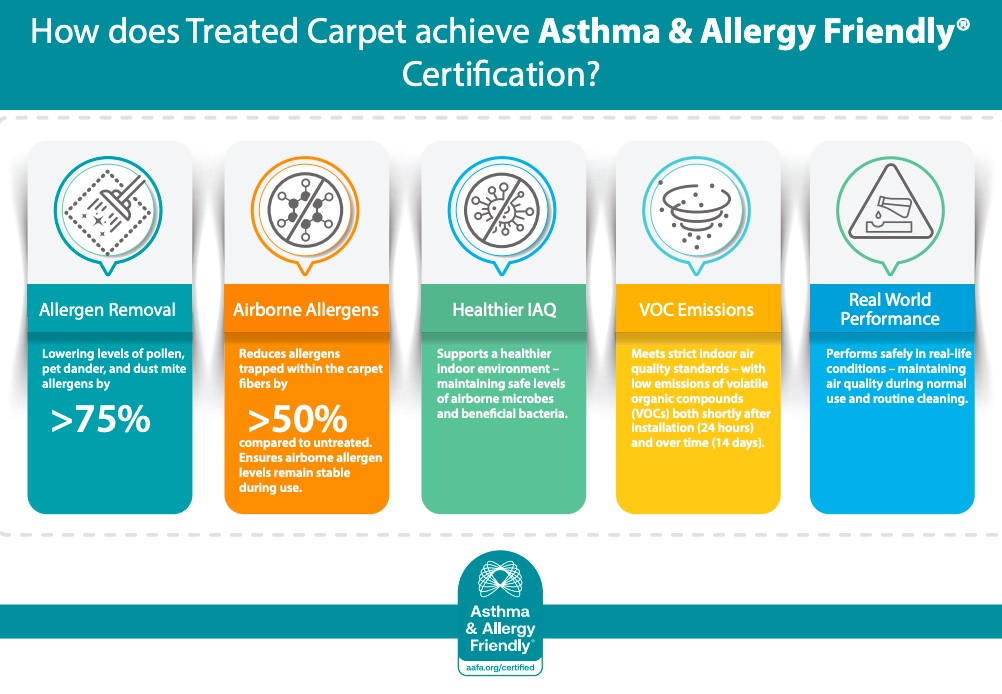
The five performance areas evaluated for Asthma & Allergy Friendly® Certification of treated carpet.
Rethinking Carpet
The old reflex (that carpet and allergies don’t mix) was shaped by the materials of another era. Today’s treated carpets are a different product, engineered to actively manage allergen exposure rather than collect it.
That doesn’t mean carpet is the right choice for every household, and it isn’t a substitute for broader asthma and allergy management. But for many homes, a well-chosen certified carpet can combine the comfort, warmth, and sound-softening that only soft flooring offers with real support for indoor air quality.
As with so much in a healthy home, the small, informed choices add up. Choosing materials that have been independently tested, and that can prove what they claim, is one of them.