How Choosing a Scientifically Validated Portable Air Cleaner Can Reduce Allergens and Support Healthier Indoor Environments
May is Asthma and Allergy Awareness Month, designated by the Asthma and Allergy Foundation of America (AAFA) since 1984 to highlight the challenges of asthma and allergies and their profound impact on individuals and families. With asthma and allergy symptoms often peaking during the spring season, this is a meaningful time to consider the role indoor air quality (IAQ) plays in managing these conditions, and how the products we choose for our homes can make a real difference.
Ensuring clean indoor air is one of the most important steps we can take toward maintaining a healthy living space. Surprisingly, the air inside our homes can often be more harmful than the air outside, as it contains a variety of pollutants. Everyday activities like cooking, cleaning, painting, and even burning fuel and candles release particles and chemicals such as volatile organic compounds (VOCs) into the air. Add to that common allergens like pet dander, pollen, mold spores, and dust mite allergen, and it is clear that indoor air quality can have a serious impact on our health.
One of the most effective tools for achieving cleaner air is a portable air cleaner. These devices can significantly reduce airborne allergens and pollutants, helping create a healthier environment for you and your family. Indoor air pollution ranks among the top five environmental risks to public health, and with more of us spending extended time indoors, portable air cleaners can be a game changer for anyone seeking better IAQ, especially individuals with asthma and allergies. Let us explore why these devices matter and how to make sure you are selecting one that truly works for you.
Why Air Quality Matters Now More Than Ever
We know the dangers of poor outdoor air quality, from car exhaust to industrial pollution, but did you know that indoor air can be up to five times more polluted? Dust mite allergen, pollen, pet dander, and mold spores circulate in the air and settle on surfaces, only to be stirred up again when someone walks across the room or sits on the couch. For those with asthma or allergies, these particles can trigger symptoms, making it hard to find relief indoors.
That is where portable air cleaners come in. Designed to filter out these irritants, portable air cleaners can help create a healthier living environment. But not all devices are created equal, and understanding what makes a good air cleaner is key to making an informed purchase.
What Makes an Effective Portable Air Cleaner?
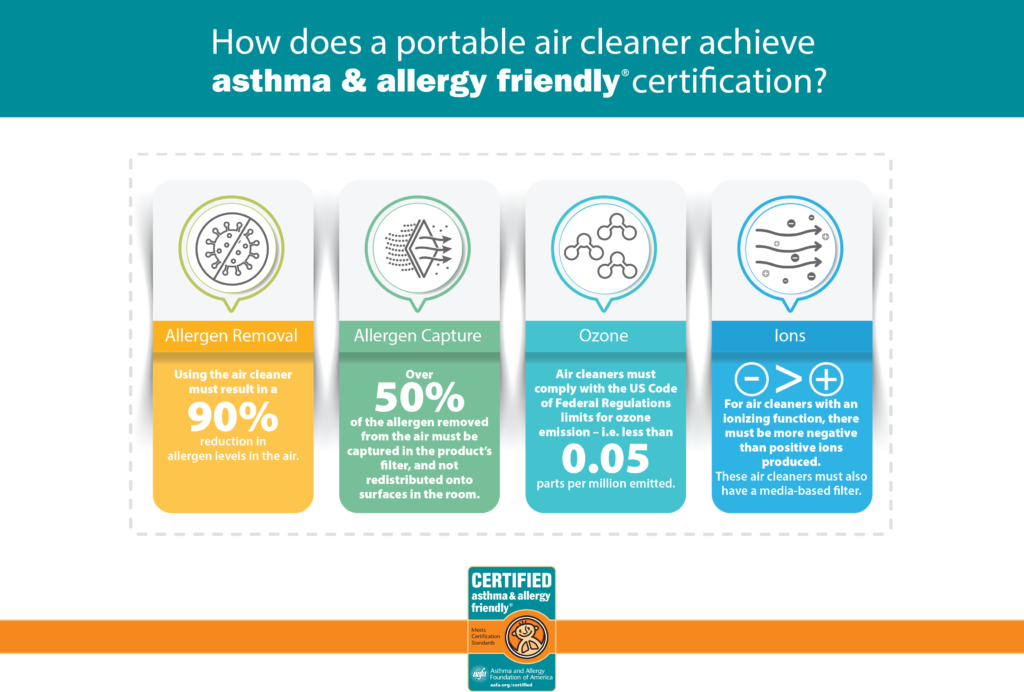
While many air cleaners promise to improve indoor air, how many manufacturers can back those claims with solid scientific evidence? The Asthma & Allergy Friendly® Certification Program was developed to give consumers confidence by rigorously testing products in real-world conditions. A portable air cleaner must meet strict performance standards before earning this certification, ensuring that it not only removes allergens but also prevents them from re-entering the air you breathe.
Here is what goes into certifying a portable air cleaner:
Removing Allergens from the Air: To earn the Asthma & Allergy Friendly® Certification, air cleaners must reduce airborne allergen levels by at least 90%. Testing simulates real-life scenarios in a controlled chamber, complete with carpet, furniture, and allergen-laden dust. The air cleaner must prove its ability to capture allergens of different sizes, including dust mite allergen, pollen, and cat allergen particles.
Capturing the Allergen, Not Just Moving It: It is not enough to just filter the air. Certified air cleaners must also demonstrate that they capture the allergens in their filter rather than just moving them to another surface where they could be stirred up again. At least 50% of the allergens removed from the air must be captured within the air cleaner’s filter.
Keeping You Safe from Ozone: Some air cleaners generate ozone, a gas that can irritate the lungs and worsen respiratory issues, particularly in people with asthma. The Asthma & Allergy Friendly Certification ensures that any ozone produced by the air cleaner is kept at extremely low levels (less than 0.05 ppm), making it safe for indoor use.
A New Sub-Category for Compact Portable Air Cleaners
In November 2025, Allergy Standards Limited (ASL) expanded the Air Cleaner Certification Standard (ASP:08) with the addition of a new sub-category, ASP:08-09, designed specifically for compact portable air cleaners. This update reflects a clear shift in how people are thinking about indoor air. With the rise of remote work, the popularity of personal air cleaning devices, and growing demand for solutions in smaller environments such as bedrooms, nurseries, dorms, and home offices, manufacturers are increasingly developing desk-sized, travel-friendly, and modular air cleaners.
ASP:08-09 applies to portable air cleaners typically designed for spaces of up to 250 square feet, with mechanical filtration and a Clean Air Delivery Rate (CADR) below 170 cfm. To achieve Asthma & Allergy Friendly® Certification under this sub-category, a product must demonstrate a greater than 75% reduction of airborne allergens compared to an inactive control for at least one tested allergen, recover more than 50% of that allergen reduction within the air cleaner itself, and maintain ozone emissions below 50 parts per billion (ppb). This expansion ensures that certification standards keep pace with evolving product categories, giving consumers clear, science-based guidance even when shopping for smaller devices.
Types of Filtration to Consider
There are several types of filtration technology used in portable air cleaners, and knowing the difference can help you make a more informed choice.
HEPA Filters: Simply put, this is a fine mesh folded a bit like an accordion that traps particles as air is pushed through it by a fan. It can trap 99.97% of particles 0.3 microns or larger. These filters trap common allergens like dust, pollen, and pet dander.
Activated Carbon Filters: These filters are great for tackling gases and odors, like those from household cleaning products or paint. While they may not capture allergens, combining a HEPA filter with an activated carbon filter can tackle both particulate matter and odors.
Electrostatic Filters: These filters charge particles as they pass through, causing them to stick to metal plates. While effective at trapping particles, it is important to ensure they do not generate harmful ozone.
UV Light: UV light is capable of killing microorganisms, and UV light sources can sometimes be present in room air cleaners and HVAC systems. UV light requires time to kill microorganisms, so make sure that any system using it is genuinely effective rather than simply a sales pitch.
Ionizers and Ozone Generators: Air cleaners that emit harmful quantities of ozone during air purification are not recommended, as inhaling ozone can cause harmful health effects. While ionizers are sometimes linked to health concerns due to the potential impact of positive ions, research supports the safety of air cleaners that produce predominantly negative ions.
Our Certified Air Cleaner Partners
We are proud to partner with Alen, Rabbit Air, LG, Blueair, and CleanForce, all of whom are committed to improving indoor air quality through their Certified Asthma & Allergy Friendly® air purifiers.
Alen: An Austin-based innovator of high-performance air purifiers, Alen has continued to expand its portfolio of Certified products. Following the certification of the BreatheSmart 35i, 45i, and 75i in 2025, Alen has added the BreatheSmart 25i to its line of Certified air purifiers, this time under the new ASP:08-09 sub-category for compact portable air cleaners. Optimized for smaller spaces such as bedrooms, nurseries, and home offices, the BreatheSmart 25i reflects Alen’s adaptive and customer-focused approach to delivering high-performance air purification for today’s modern living environments. Warburg Lee, CEO of Alen, said:
“This certification validates the science and performance behind our technology and confirms that the 25i effectively reduces airborne allergens and irritants that impact people with asthma and allergies.”
Rabbit Air: A longstanding partner, Rabbit Air has been a leader in air purification for over two decades. Their Certified products, designed for homes and healthcare environments, provide peace of mind for those impacted by asthma and allergies. With initiatives like placing Certified air purifiers in doctors’ offices, Rabbit Air ensures that individuals have access to cleaner air in medical spaces.
LG: LG has been a pioneer in developing a range of Certified appliances. Their Whole Home approach to better indoor air quality includes Certified air purifiers, laundry systems, steam stylers, and vacuums. By adopting a portfolio approach to certification, their products can significantly reduce allergen exposure in the home.
Blueair: Certified since February 2025, Blueair’s Classic Pro CP7i Air Purifier carries the Asthma & Allergy FriendlyCertification mark. Andy Lu, CEO of Blueair, said:
“We are thrilled to partner with the Asthma and Allergy Foundation of America and Allergy Standards Limited, as their rigorous scientific testing validates the effectiveness of our technology in reducing airborne allergens. This certification reinforces our dedication to providing high-performance air purification solutions that support improved indoor air quality and overall well-being for those affected by asthma and allergies.”
CleanForce: Dedicated to delivering high-tech air purifiers, CleanForce became Certified in 2024. Their solutions are widely available and offer a healthier home environment for households looking to reduce allergens and improve IAQ.
Making the Right Choice for Your Home
When selecting a portable air cleaner, it is essential to consider the size of the room in which it will be used. The Clean Air Delivery Rate (CADR) can help you determine if the device is powerful enough for the space. Air purifiers with higher CADR ratings will be able to clean the air within a space more quickly than models with a lower CADR rating. If you purchase an air cleaner with a CADR rating too low for your room, you will find it ineffective.
While CADR is a useful tool to assist in selecting an appropriate air cleaner, you should also consider the environment in which it is to operate. Your indoor air is very much a function of your outdoor air, so if you live in an area with high environmental particulate load, this will impact how often you need to change your filter, and how long you need to leave your air cleaner on. In areas affected by wildfires or high outdoor pollution, filters may need to be changed more frequently, and air intake should be set to recirculate rather than draw fresh air.
Beyond technical specifications, look for third-party certifications like the Asthma & Allergy Friendly® mark to ensure the air cleaner has been independently tested and proven effective in real-world conditions. With the addition of ASP:08-09, that same level of independent validation now extends to compact air cleaners designed for smaller rooms, so consumers can find a Certified option suited to the space they are looking to protect.
Final Thoughts
As we observe Asthma and Allergy Awareness Month, now is the perfect time to take steps toward improving the air in your home. Portable air cleaners are an excellent addition to your overall strategy for better IAQ, and with the introduction of certification for compact portable air cleaners, science-based guidance now extends to the smaller spaces where many of us spend the most time. By investing in a high-quality, validated air cleaner, you are not only improving the air you breathe but also taking a proactive step toward proactive step toward creating a healthier indoor environment for you and your family.